
SEO vs GEO: Key Differences and Why GEO Matters in 2026
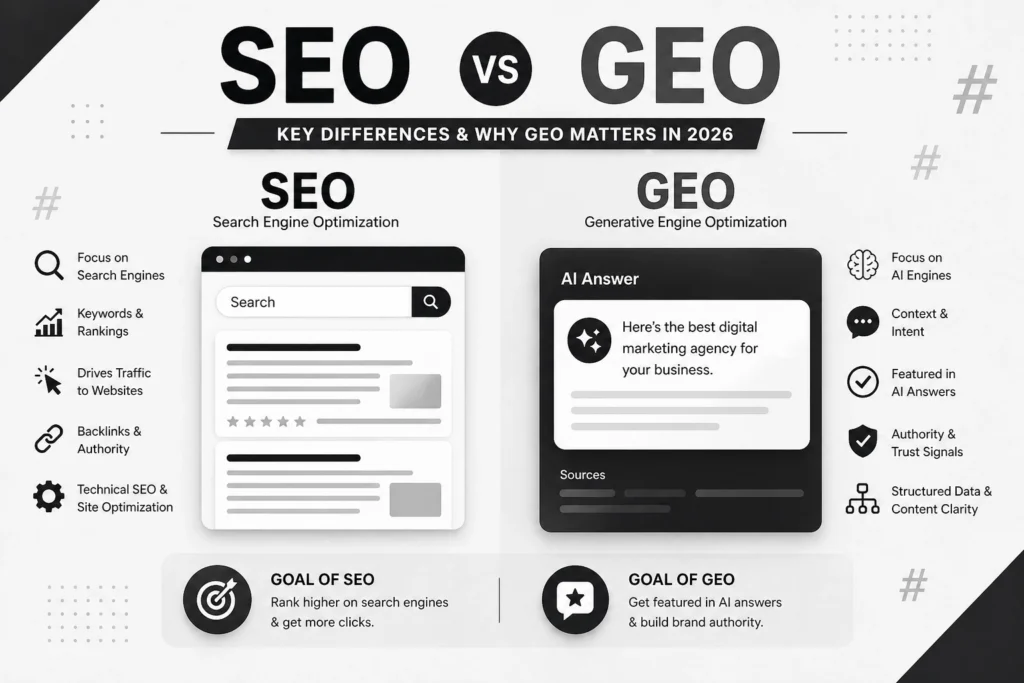
In today’s fast-changing digital world, understanding SEO vs GEO is essential for businesses that want to stay competitive. Traditional Search Engine Optimization (SEO) has long been the foundation of online visibility, but now Generative Engine Optimization (GEO) is reshaping how content is discovered.
The comparison of SEO vs GEO is no longer optional. It helps businesses adapt to AI-powered search, improve visibility, and connect better with their audience.
Understanding the difference between SEO and GEO is essential for businesses that want to stay competitive and relevant in this AI driven era.
What is SEO in SEO vs GEO?
According to Google SEO guidelines, creating high-quality, user-focused content is essential for improving search rankings and visibility.
Search Engine Optimization (SEO) is the process of improving your website’s visibility on search engines like Google. The goal is to rank higher in search results and attract organic traffic.
SEO focuses on:
- Keyword optimization
- High-quality content
- Backlink building
- Technical improvements
- User experience
For example, when users search for services online, SEO helps your website appear among the top results.
What is GEO in SEO vs GEO?
Generative Engine Optimization (GEO) is a modern approach that focuses on optimizing content for AI-driven platforms. Instead of just ranking on search engines, GEO ensures your content is selected and used by AI tools.
GEO focuses on:
- Context-rich and meaningful content
- Conversational and clear answers
- Authority and trust signals
- Structured and easy-to-read information
- Understanding user intent
In simple terms, SEO vs GEO can be understood like this:
SEO helps users find you, while GEO helps AI choose you.
SEO vs GEO: Key Differences Explained
Understanding the difference between SEO vs GEO helps you build a smarter strategy.
1. Search vs Answer-Based Approach
SEO focuses on ranking web pages, while GEO focuses on providing direct answers through AI systems.
2. Keywords vs Context
SEO relies on keywords, but GEO prioritizes meaning, intent, and context.
3. Traffic vs Visibility
SEO drives users to your website, while GEO increases visibility across AI platforms and tools.
4. Traditional Search vs AI Ecosystem
SEO works mainly on search engines. GEO works across AI tools, voice assistants, and smart platforms.
5. Content Style
SEO content may focus on keywords, but GEO content must be natural, helpful, and easy to understand
Why GEO is Becoming Important Now
The growing importance of SEO vs GEO comes from how user behavior is changing. People now expect quick, accurate answers without browsing multiple websites.
Here’s why GEO matters:
- Rise of AI Search
Users are increasingly relying on AI tools for instant information. - Zero-Click Searches
Many users get answers directly without visiting websites. - Improved Visibility
GEO helps your content appear in AI-generated responses. - Stronger Authority
High-quality and structured content builds trust with AI systems. - Future-Proof Strategy
GEO prepares your brand for the next phase of search evolution.
How to Optimize for SEO vs GEO
To succeed in SEO vs GEO, you need a balanced strategy that combines both approaches.
1.Focus on User Intent
Create content that answers real user questions clearly.
2. Use Simple and Structured Content
Break content into headings, bullet points, and short paragraphs.
3. Build Authority
Share insights, expertise, and valuable information.
4. Write Conversational Content
Make your content easy to read and understand.
5. Stay Consistent
Regular updates improve visibility and performance.
Common Mistakes to Avoid
When working on SEO vs GEO, avoid these mistakes:
- Keyword stuffing
- Low-quality or copied content
- Ignoring user intent
- Poor content structure
Instead, focus on value, clarity, and usefulness.
SEO vs GEO: Not Competitors, But Partners
It’s important to understand that SEO vs GEO is not about choosing one over the other.
SEO helps bring traffic to your website.
GEO ensures your content is trusted and recommended by AI systems.
Using both together creates a powerful strategy that improves visibility, reach, and engagement.
Conclusion
The comparison of SEO vs GEO shows how digital marketing is evolving. While SEO remains essential, GEO is becoming equally important in an AI-driven world.
Businesses that combine both strategies will have a strong advantage in visibility and growth. By focusing on quality content, user intent, and structured information, you can succeed in both traditional and modern search environments.
In the future, SEO vs GEO will define how brands connect with their audience. Adapting now ensures long-term success in the digital space.